
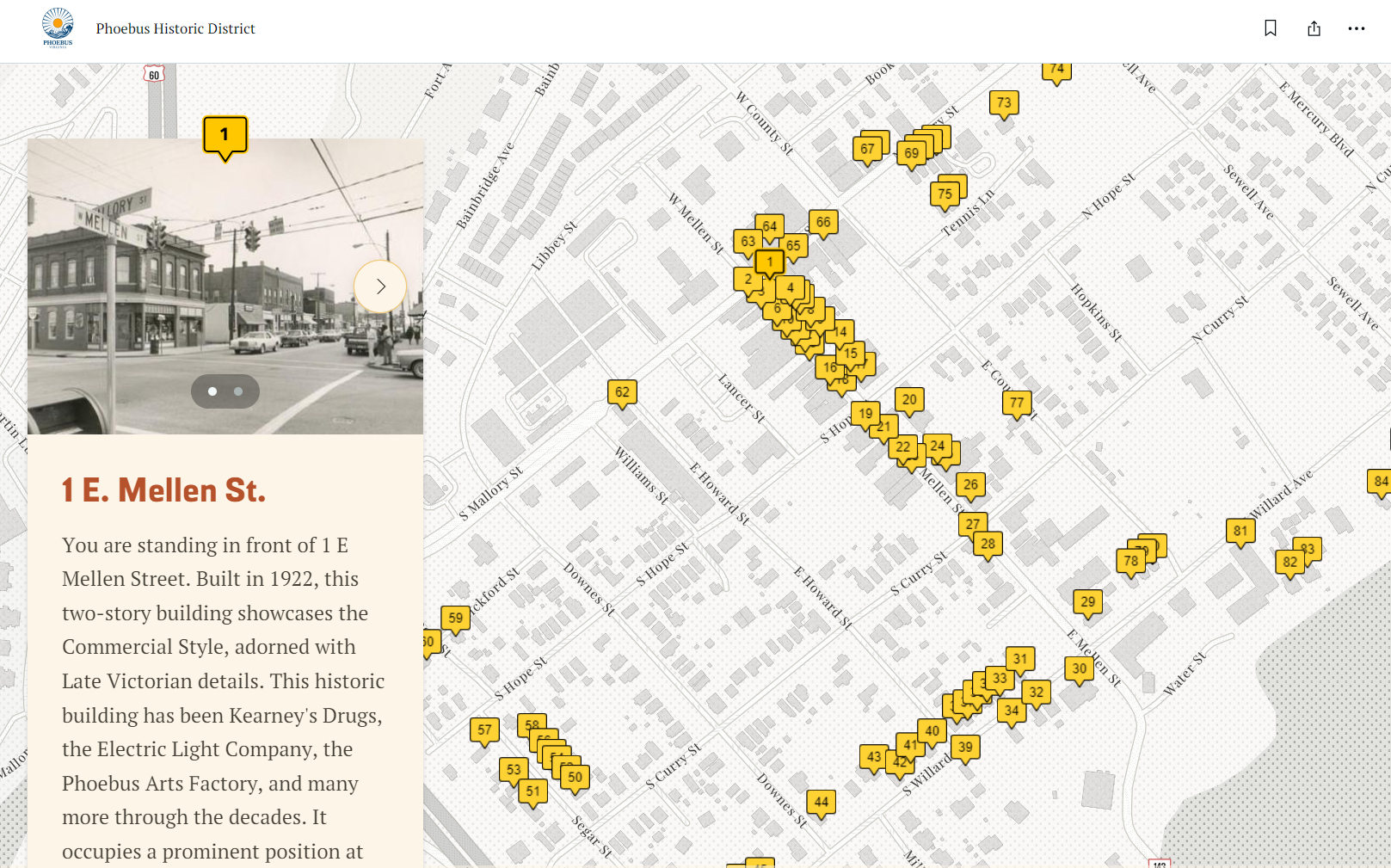
The Phoebus Partnership fosters continued exploration of their historic district through the Phoebus Historic District Self-Guided Tour. The virtual, self-guided tour features information about all contributing structures within the City of Hampton’s 86-acre historic district—including detailed descriptions of architectural styles, historic events, and previous business occupants, along with community-sourced photos.

Last summer, after finding a similar project in Frankfort, Kentucky, the Partnership’s Design Committee set off to create a platform that allows users to explore Phoebus’ rich history at their own pace. The tour is hosted on a the free-to-use app powered by ArcGIS StoryMaps, which was selected as the platform because of its low learning curve. Visitors access the tour by scanning QR codes found on signs that were strategically placed throughout the district and mounted (in-kind) on existing lamp posts by the City’s Public Works Department.
There are two walkable, bicycle-friendly routes—one encompasses the commercial district and waterfront and the other covers the historic residential neighborhood—that each take less than an hour to walk at an easy pace. Through the self-guided tour, users can explore historical documentation from the National Register of Historic Places for each building and view historic photos sourced from the community. Since its launch in November 2023, the tour has been well-received by both visitors and residents alike—fostering community pride and boosting tourism.
“Phoebus has always had a strong sense of identity, and the public’s reaction to the launch of the self-has been overwhelmingly positive. It’s a real joy to walk down the street and see people scanning the QR codes to learn more about the buildings around them. Turns out that not just residents and business owners love to learn more about their buildings, but visitors and tourists are enthralled with the unique history all around them.” – Joe Griffith, Phoebus Partnership Board Member and developer

The project cost the Partnership approximately $1,200—to print 13 street signs at the local FastSigns—and over 185 volunteer hours to implement. Moving forward, they will pay $10 per month for account hosting. Key project partners included local historian Tim Receveur, developer Joe Griffith and the City of Hampton.
The Phoebus Historic District Self-Guided Tour is a great example of a low-cost, high-impact project that makes their vibrant history accessible by leveraging modern technology and community engagement.
Photo credit: The Phoebus Partnership
 Virginia Main Street