If you go looking for problems, that’s what you’re going to see. But, what if you had tools to help you amplify what is going right in your organization, at any stage of development?
I (Kyle Meyer) have the pleasure of working with the Town of Urbanna, which is currently a Virginia Main Street (VMS) Exploring Main Street community. They are working to jumpstart a local Main Street effort aimed at embracing economic growth opportunities for their historic downtown located on the Chesapeake Bay. In the infancy of their program, the startup board wanted to focus on their initial steps to move toward a fully functioning and impactful organization.
To harness their leadership’s momentum and local assets, I utilized a facilitation approach that complements these strengths. Appreciative Inquiry (AI) is a positive approach to organizational change that focuses on maximizing an organization’s strengths instead of merely looking for problems to fix or avoid. Building upon the framework of positive psychology and human sciences, AI shifts our focus, attention, and energy toward exploring opportunities and possibilities.
Forbes highlighted AI in a recent article, with writer Mark Sparvell explaining the process and its benefits in easily understandable terms:
“When you gift your team permission to focus on their strengths, you boost their confidence, which expands their ability to develop innovations and invites new ideas.” – Mark Sparvell
Appreciative Inquiry engagements are designed and delivered using the 5-I process: Initiate, Inquire, Imagine, Innovate, and Implement. During the “Initiate” step, leadership designs the engagement by deciding who should participate, when and how stakeholders should be engaged, and crafting the questions to ask participants. A helpful starting place to explore the rest of the 5-I process is to design the engagement around SOAR (Strengths, Opportunities, Aspirations, and Results):
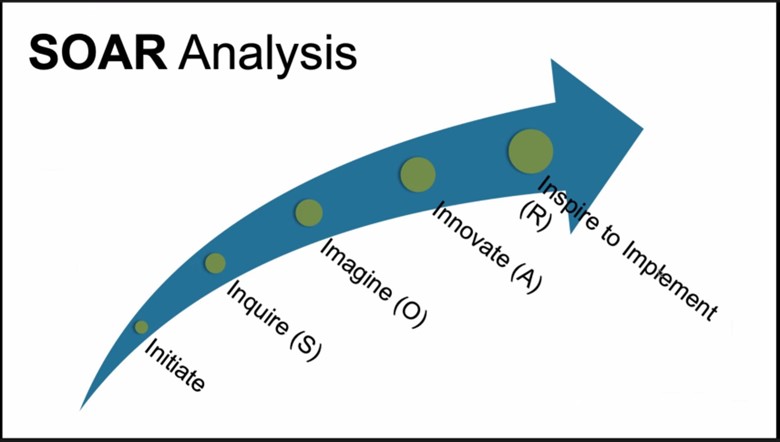
- Strengths: What are we great at?
- Opportunities: What are the possibilities?
- Aspirations: What are our dreams or wishes?
- Results: What are meaningful outcomes?
Utilizing SOAR within the AI process sparked enthusiastic, organic discussions, yielding outcome-oriented ideas to drive Urbanna Main Street leadership’s strategic agenda. Questions were crafted to address the purpose of starting up a program, focusing on the current needs of the organization to get started and achieve easy wins to stoke momentum, see full slide deck here:
- What are a couple of strong points, ones that you think are critical to our success and thus need to be maintained in the future?
- What are a couple of important opportunities to improve and grow? What is important for us to do better?
- What are your highest aspirations for the future of our organization? What do you most hope might happen?
- What results would you most like to see us accomplish over the next three years?

This approach, grounded in strengths and results, resonates with the asset-based economic development framework of the Main Street Approach, a practical and adaptable method for downtown revitalization across diverse local contexts. In this case, Urbanna’s startup board was able to imagine the possibilities for their organization and hone in on the initial steps to begin their journey: establish a 501(c)(3) nonprofit and create an Urbanna Main Street strategic plan. Their first win was applying for and being awarded a VMS Community Vitality Grant (CVG) to get the initiative moving!
To amplify what is going right for your organization, check out the resource below:
Learning to SOAR: Creating Strategy that Inspires Innovation and Engagement

Image Credit: Etsy
 Virginia Main Street